


How to Write Chord Progressions
From your first major loop to seventh chords, secondary dominants, and borrowed chords. Free video lessons for beginner and intermediate songwriters.
By Jake Lizzio · Signals Music Studio · 700,000+ subscribers on YouTube
Here's how you write an amazing chord progression: start with the diatonic triads of a key, enhance those chords into suspended and/or seventh chords, introduce secondary dominants and passing diminished chords, and employ borrowed chords.
To help you learn these concepts, I've organized 8 video lessons that cover each topic. You might be surprised how quickly you go from "I can't write a thing" to "this sounds amazing!" I'm also providing this PDF which comes directly from my Theory & Songwriting course. That course contains over 40 helpful quick guides like this one, along with worksheets and a guided curriculum to learn useful and practical music theory.
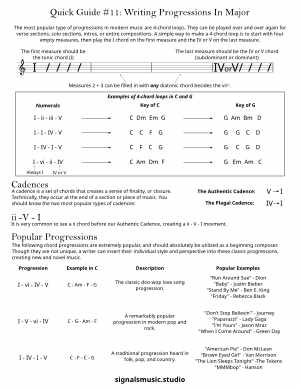
Disclaimer: These lessons try their best to avoid the "annoying music theory" and get straight to the good stuff. That means we're going to be ignoring the small details in exchange for quicker results. At a certain point though, you will need to know your fundamentals like intervals, scale degrees, and triad construction. To learn those concepts, visit here. If you already know basic theory but still can't compose, then you're about to level up!
The Quick Version
Here are the steps and concepts we're going to tackle in order. To write a chord progression:
- Pick a scale: major or minor.
- Write out those notes, then assign them their proper diatonic chord and roman numeral.
- Write a 4 or 8 chord loop, starting on the tonic chord.
- Try turning each chord into a diatonic seventh chord.
- Apply chord inversions to make the bass more interesting.
- Use suspended chords to create tension, or remove color.
- Introduce secondary dominants to start leaving the safety of the key.
- Use passing diminished chords to add potent tensions.
- Introduce borrowed chords to your progression, creating a shift in mood.
- Try modulating or changing keys.
If you're uncertain about any of those concepts, you're in the right place! We'll start with the simple stuff first.
Diatonic Chord Progressions in Major
Astonishingly, over 80% of the music you'll hear out in public on a daily basis is written using the following strategy. I made up that statistic but I still stand by it - diatonic major progressions are exceedingly popular, and are absolutely the best place to start when trying to master harmony.
If you're more into metal and rock styles, this may seem like a drag because these chords tend to sound happy, poppy, and upbeat. Don't worry though - the next lessons will introduce darker sounds.
Watch through this video to understand the basics. By the end, you'll be able to write the same progressions you hear on the radio every single day.
Watch the full lesson: How To Write Chord Progressions
Here's a recap. To write a progression in major:
- Pick a major scale and list its notes.
- Assign each note its own numeral/chord. 1-4-5 get major chords, so they're written as I IV V. 2-3-6 get minor chords, so we write them as ii iii vi. The seventh chord is diminished, so we write it like this vii°.
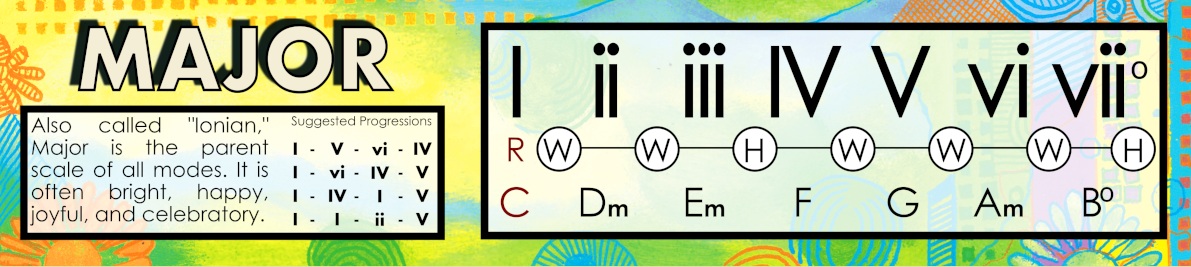
- Once you've got that list of 7 chords, arrange them into loops by starting with I and closing with IV or V. You'll always get something that sounds good, and easy to play on top of: just pick the notes of the major scale and sing them on top, or play them with another instrument.
Follow this strategy and you just might write the most popular chord loop in history - the "one five six four," which we see below in the key of C:
Curious about that diminished chord we ignored? We'll discuss it soon, keep reading!
Writing Chord Progressions in a Minor Key
Major is inherently "happy" and "bright," as you probably just heard. Minor is the dark side - these progressions will sound more sad, serious, and tumultuous. I go through all the details here:
Watch the full lesson: How to Write Chords and Songs in Minor
To write a progression in minor, first pick a minor scale, then assign it the proper diatonic chords according to its Roman numeral formula, which looks like this (demonstrated in C minor):
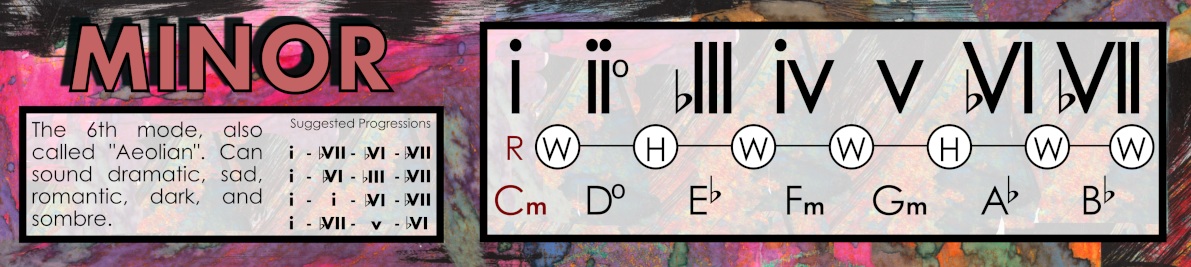
You can mix and match those chords just like before - just remember to start on i (Cm). For beginners, I suggest trying to just write using the following chords: i, iv, bVI, and bVII. Any combination of them will result in a great chord movement like the following:
That chord progression is diatonic to C minor - it only uses notes and chords that come straight from the Cm scale. But when writing in minor, it's extremely popular to "break" the scale, and feature "outside" chords and notes.
The V chord for example is extremely popular in minor key music, even though it requires the use of a major 7th (which the minor scale does not have). Listen to how nice it sounds here:
If you'd like to fully understand this behavior, pause your progression studies here to study the harmonic minor scale. That's the scale you create when you lift the minor scale's 7th note up a semitone. We frequently hear it used alongside the minor scale to create progressions like this one above, which is popular enough to get its own name: The Andalusian Cadence. And yes, I've made a lesson on just that progression, which you can find here.
The Dominant Chord
When you're in major, or minor, there is one chord that will bring you home to your tonic chord (i or I) with authority: the V chord. It really does a great job of preparing your ear for a final crash into i or I.
We just learned that V is not technically from the minor scale, because V requires a scale with a leading tone, which the minor scale does not have. But V is completely diatonic to major keys.
In either case though, V gets a special title: The Dominant Chord. It doesn't matter what key you're writing in, this title always refers to V - a major chord that's built off scale degree 5.
Be warned though - the word "dominant" has many usages in music theory. For example, a dominant chord just refers to a dominant seventh type of chord. We'll discuss that type of chord soon, but until then, note that a dominant chord is different from the dominant chord.
Chord Inversions and Slash Chords
When we rearrange the notes of a specific chord, we can get a chord inversion that sounds and feels a bit different than the original configuration. This is helpful for creating more intriguing chord progressions with specific bass movements.
For example: In the key of C, the V chord (G) contains the notes G - B - D in order, with G being the lowest note. If we instead place the B as the lowest note, we'll get a G in first inversion (classically called G63, but also called G/B).
This chord is an excellent alternative to just regular G. To see why, let's start on a C chord, then move to this new inverted G chord. Notice how our bass voice (the lowest note in the progression) only needs to drop down a half-step. This creates a nice, gentle, falling sound in the bass that wasn't possible when playing G in "root position".
I go over all the details of inversions, their labels, and their applications here in this lesson:
Watch the full lesson: How Inversions and Slash Chords Create Better Progressions
Diatonic Seventh Chords (The Harmonized Major Scale)
As mentioned earlier, we're taking shortcuts here that might cause some confusion. This topic could be trouble if you don't know your intervals, how to harmonize in thirds, and how chords are constructed. You can find those lessons in my Theory and Songwriting course, but also in my book.
To simplify things - the major scale can create more than just major or minor triads. The I chord in C doesn't have to just be C, it could be Cmaj7 instead, which is a wonderful-sounding replacement. And that V chord, G, can be played as G7 to create more interest without leaving the scale.
Here's the shortcut: just memorize this chart. I and IV both become maj7, while V becomes "dominant seventh" which we just write with "7". The ii, iii, and vi chord all become m7 (minor seventh) chords.
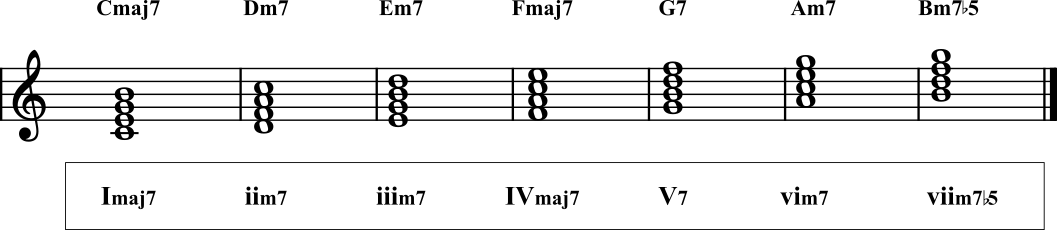
With this knowledge, you can start improving and upgrading the diatonic progressions you've just written in major and minor. For example, here's that classic I - V - vi - IV again, but now each chord is "extended" into a seventh chord.
To hear and see this in action, check out the video here:
Watch the full lesson: How To Write Progressions With 7th Chords: maj7, m7, & 7
Suspended Chords (Sus2 and Sus4)
Suspended chords (or sus chords) do not have a third in them, which makes them impossible to sound like major or minor triads. They can be used as neutral stand-ins for major or minor chords, or be used side-by-side with their unsuspended kin to create wonderful movements. They come in two flavors: sus2 or sus4, pronounced "suspended second" or "suspended fourth."
Nearly every diatonic chord can be replaced with sus2 or sus4 without leaving the key. The exceptions are the iii chord, which can only be played as sus2 (not sus4), and the IV chord, which can be played as sus4, but not sus2.
Do keep in mind - just because something is out of key does not mean it will sound bad, or that you shouldn't use it. The focus of these lessons, though, is to fully explore diatonic harmony and the tricks that commonly help you break those patterns. After you're done with these lessons, you should be equipped to experiment with more non-diatonic chords that leave the safety of a single scale.
To apply these chords, I recommend you watch the video below, because there's a lot to cover. But to try and summarize, we use suspended chords:
- To delay, or suspend, a resolution (using either Isus or Vsus or both)
- To "get more mileage" out of a single chord
- To remove a chord's major/minor qualities.
Secondary Dominants
Sick of staying in the scale? Try these chords out - they're guaranteed to sound great and will quickly orient you back to the safety of a key. Secondary Dominants are chords that aren't diatonic, but they lead you back to diatonic chords.
Let's take a look at the key of C again, which has a vi chord of Am. Ask yourself - what's a strong way to land on an Am chord? Hopefully, you remember learning about THE dominant chord, the chord that pulls you strongly to a resolving point. Well the dominant chord of A minor is E, and you can hear that playing E can strongly land our ear to Am.
Now E isn't in the key of C, but who cares? If we're playing in C, we can introduce E in briefly just so it propels us towards our vi chord, Am. E is the dominant chord of vi, which is why we write it as V/vi.
These chords will often (but not always) be played as dominant seventh chords as well, as heard in this example:
To learn about the other secondary dominants and hear more examples of them in use, watch the whole video below:
Watch the full lesson: Secondary Dominants: Write Better Chord Progressions!
Diminished Chords
Black pepper is a great ingredient to add flavor and depth to your dishes, but it's not the kind of thing you want to eat all on its own. Similarly, diminished chords are pretty gross in isolation, but truly beautiful when they fit into a progression.
We can spend a year talking about these chords and their many applications, but today we'll just address this easy technique: diminished seventh chords can easily "plug the gap" between two diatonic chords that exist a whole step apart from one another.
IV and V for example are separated by a whole step. That means you can plug the gap with a diminished seventh chord, shown here in C:
Technically, this is known as a "secondary leading tone chord," a topic covered in depth in my book the Chord Progression Codex. You'll eventually want to know the difference between a full diminished and a half diminished chord, and when to choose one over the other. For now, just try seeing if you can use them in this fashion of plugging the gap (commonly called a "passing diminished chord").
Watch the full lesson: 5 Easy Ways to Use and Write with Diminished Chords
Borrowed Chords
We're going to close things off here because it's the last topic that doesn't require a lot of theory. All you need to do is write in major, but grab a chord now and then from the parallel minor. Parallel just means "starts on the same note," so in practice, we'll be writing in C major but sometimes featuring chords from C minor.
Here's those two scales and their chords lined up side by side so you can see their differences. These images come from my Ultimate Modal Poster, the prettiest music poster you'll ever see!
With those in mind, let's try writing a simple progression using chords from C major, but then introduce a "borrowed chord" from C minor to create any of the following:
This is the easiest type of "modal mixture" or "modal interchange," but the topic can go much much deeper. To get a grasp of the basics, and a peek at what's beyond, watch this video here:
Watch the full lesson: Writing Progressions with Borrowed Chords
Next Steps
Are you still with me? If so, great job - you should now have the skills to write a banger of a chord progression already. But if you're like many of my students, this still isn't enough. What about voice leading? Augmented chords? Modulations? Ninth chords?
All that stuff is awesome, and the more you know, the more you can craft your progressions into stunning harmonic structures. If you're ready to take the dive into the next level, I'll offer two proven paths.
1. The Chord Progression Codex
This 430 page spiral-bound tome is completely focused on chords and progressions. It doesn't discuss rhythm, melody, bass, groove, or anything else unrelated to harmony. By the end, you'll literally know all the chords, and how to use them, while analyzing how they've been used in popular music.
Explore the Chord Progression Codex
2. Theory and Songwriting Course
This course teaches the critical skills of songwriting, and explains all the required theory, covering important topics like song structure, melody crafting, and improvising. The early chapters provide a solid foundation of basic theory, with a focus paid to the guitar and fretboard knowledge. Later chapters explore more theory and the core skills for composers, like adding rhythm, melody, solos, and structure to chord progressions to turn them into full songs.
Explore the Theory and Songwriting Course
The Full Series
Here's the whole playlist - 7 video lessons that take you from your first diatonic progression to the color chords the pros use.


Frequently Asked Questions
What is harmony?
Harmony just means "more than one note at a time". Chords and progressions are just a specific type of harmony.
What does diatonic mean?
In music theory, diatonic means "within one scale." The diatonic triads of a major scale are all the triads that can be built using only those notes.
Do chord progressions have to be diatonic?
Nope, but learning diatonic harmony is the best place to start in my opinion. Learn those "rules," and then break them.
What's the most popular major chord progression?
These days, it's still I - V - vi - IV. In C, that'd be C - G - Am - F. In G, it's G - D - Em - C.
What's the most popular minor chord progression?
Any combination of i, bVII, and bVI. In Am, that'd be Am, G, and F. In Em, it's Em, D, and C.
Do you switch scales over each chord?
No, that's not necessary. If you've written a diatonic chord progression, all those notes came from a scale. Just use that single scale on top of every chord for melodies and solos.
What is voice leading?
Voice leading refers to the motion of independent voices within each chord, and how they move. Carefully arranging voices can lead to more "rich" sounding harmonies.