


How To Write Progressions With 7th Chords: maj7, m7, & 7
Learn how to use Major 7, minor 7, and dominant 7 chords in your progressions, adding more color and interest to your harmony.
By Jake Lizzio · Signals Music Studio · 700,000+ subscribers on YouTube
To write a chord progression using seventh chords, you should first learn which seventh chords exist in the diatonic major and minor scales. Then, you can replace any ordinary triad in a progression with its appropriate 7th chord to start adding color and interest to your progressions.
We explore exactly how to do that in this video lesson, while getting familiar with the unique flavors and moods that each seventh chord creates.
If you're pressed for time, or don't want to watch the video lesson above, here's a summary of what's taught.
Major 7th chords
To create a major 7th chord, start with a major triad. Go up a major seventh interval from the root of the chord, and add in that note. You'll get a major-seventh chord, which is written the following ways:
maj7
Δ7
M7
These chords have a relaxing, bright, and classy ambience to them. In major keys, you can turn the I and IV chords into maj7 without leaving the scale. Use that knowledge to transform an ordinary chord progression into a jazzier sounding one.
Minor 7th chords
To create a minor 7th chord, start with a regular minor triad. Then move up a minor seventh interval from the root note, and add in that note. You'll get a minor seventh chord, which is written as either m7 or -7.
These chords are less threatning and dark than regular minor triads, and tend to sound a bit softer and morose. They're also super easy to use, because all the minor triads in our diatonic scale can easily become minor seventh chords without breaking the key. That means ii, iii, and vi might all be played as m7 chords to add extra colors to an ordinary progression.
Below, we see a regular I - ii - iii - IV progression using plain triads. We previously learned that I and IV can both be enhanced into maj7 chords, so let's do that. We'll also turn those ii and iii chords into m7 chords, because every minor chord in the key can handle that transformation.
Now, our plain vanilla chord progressions are sounding much more sophisitcated with the addition of these seventh chords.
Dominant 7th chords
When people say "7th chord" they're talking about this one: the dominant 7th. It gets written with just a single 7, so "C7" means C Dominant Seventh, though we might pronounce it "C Seven."
We get a dominant 7th chord when we take a regular major triad and add a b7 scale degree to it. The only chord that can handle this addition without breaking out of the key is the V chord. In major keys, V can become V7 and it doesn't shake the tree.
In fact, just like the other examples here, it sounds quite good. V7 adds extra crunchy tension to resolve towards a regular I chord, or the enhanced Imaj7 we learned. Take a listen:
The Harmonized Major Scale
Line up the notes of the C major scale, and start on the first note C. If you start skipping notes, you'll find the notes of a C triad (C E G), then skipping another notes brings you to the note B, which forms a Cmaj7 chord. That's why the I chord "becomes" Imaj7 - it's just the result of adding an extra harmonized third.

If you do this again starting on the second note, you'll naturally create a minor seventh chord. That's why ii "becomes" iim7. Repeating the process on each note, you'll see the following:
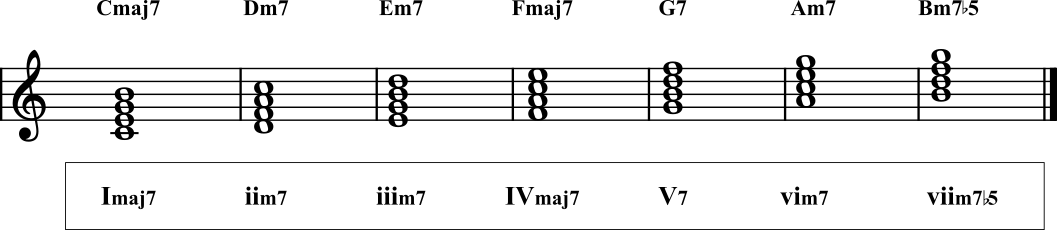
So in every major key:
I and IV become maj7
V becomes dominant 7th
ii, iii, vi all become m7
For premium members, I've created a PDF which recaps this information, and includes chord charts for guitar to create all these 7th chords starting on any note.
Get The PDF
A one page quick-guide describing the diatonic seventh chords, and movable chord charts for guitar to play any type of seventh chord on any root.
For Premium Members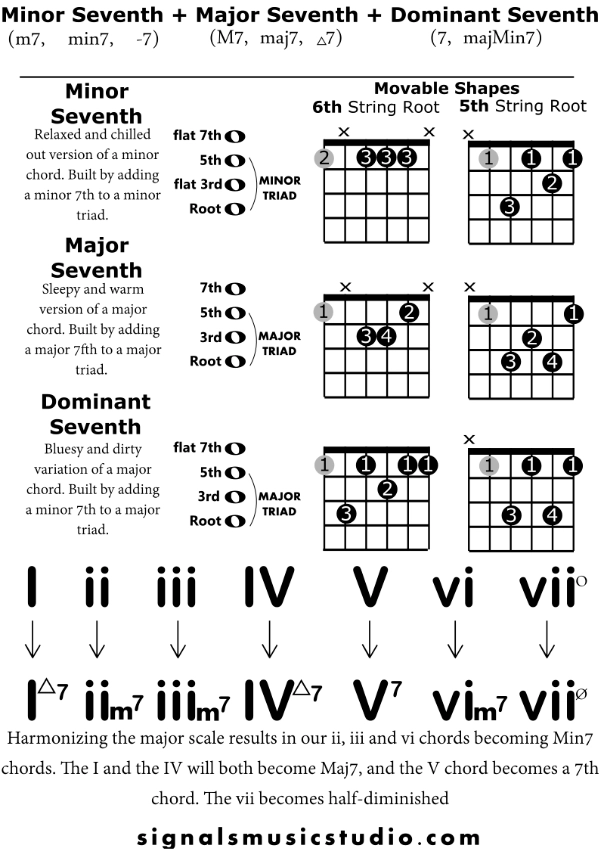
Half-Diminished Chords (m7b5)
To build a half-diminished chord (also called minor-seven-flat-five), start with a diminished triad. Move up a minor seventh from the root note and add in that note. This chord goes by two names and symbols: "half-diminished" (ø) or "minor seven flat five" (m7b5).
Though diminished triads on their own are fairly rare, this type of chord is far more popular. Its most popular uses are outside the scope of this lesson, but you can already experiment with how it resolves up a half-step to arrive at our tonic chord of C or Cmaj7.
Seventh Chords In Minor Keys
This all works identically in the minor key - just remember that minor is a mode of major and you'll find the same pattern exists. Not sure how that works? Watch my series on modes, and you'll understand how to take all of this knowledge here and apply it to the minor key instead.