

Completely Master Musical Modes
8 lessons for songwriters and players. Watch these videos, and I promise you'll never be confused by modes again.
By Jake Lizzio · Signals Music Studio · 700,000+ subscribers on YouTube
This is the version of "the modes" I wish someone had taught me when I started. Read whichever section interests you and watch the videos as you go, or scroll straight to The Full Series and watch the playlist in order.
Most musicians who "learn the modes" memorize the shapes in a few weeks and then spend years wondering what they're actually good for. That was me too. I technically knew how to play Lydian and Dorian, but didn't discover what they were good for until much later.
Understand "Parallel Modes" First
Most people are taught that modes are "just the major scale starting on a different note." While technically true, I believe it's the worst way to approach this concept as a beginner. That introduces you to relative modes, when instead, I think beginners should understand parallel modes. That's what this demonstration is all about: hearing the actual sound, feeling, and emotional qualities of Dorian, Lydian, Phrygian, and the rest. They all have their own flavors that we can develop, and this lesson shows how to do that.
We now have laid the groundwork for the theory you'll need going forward, and received a taste of those modal flavors. The next videos will build off this knowledge.
Next: Learn Relative Modes
Now that you understand how parallel modes work, let's go back to how your teacher probably taught this concept. If you play a major scale but start on the second note, you'll create a Dorian scale. That's absolutely true, but it misses the point of modes. If all you do is play the C major scale from D to D, your ear will probably just want to hear the sequence end on C. To actually create a Dorian "feeling" or tonality, we need to play the notes of C major but reinforce the idea that D is "home base." We do that by drowning our ear in the D note, and playing the triad that lives there (ii, which is Dm).
Stated broadly, to create a modal tonality you need to reinforce a tonal center that isn't the I chord. If you're playing the notes of C major, but the C major chord feels like home (i.e. is the tonal center), then you're in C major. But if you can play the notes of C and force me to hear Dm, the ii chord, as the tonal center, then we'll hear and feel D Dorian.
Another example: if you're using the notes from C major but spending all your time hanging out on its fifth note and chord (G major), you're in G Mixolydian. You're composing with the notes of C, but "rotating it" to focus on its fifth, creating the fifth mode.
This is a confusing concept to read or write about. It's much better heard, and on good speakers too, since this video includes bass frequencies that help develop those sounds. But once you're done watching, you should have a good grasp on the two ways to think about modes: parallel, and relative.
Modes For Guitar: One Shape, Every Mode
We now know that a major scale could actually be any mode in disguise, depending on what our ear hears as the tonal center. That means that guitarists (like me) can theoretically use a single major scale shape to play in any modal tonality.
Seriously.
You don't have to learn hundreds of scale shapes. You could honestly pick just one, and focus on different notes within it to develop those modal sounds. That's exactly what I demonstrate in this lesson.
This is the single most useful realization a guitar player can have about modes, because it means you can stop hoarding scale shapes and start using the ones you already have. The full breakdown is here:
The chart in that lesson is available to students who support my lessons through site memberships. $5 a month gets you access to over a hundred lessons you won't find on YouTube, plus all of my charts, practice tracks, and PDFs. If you're already a member, .
Modes And Tonic Chords
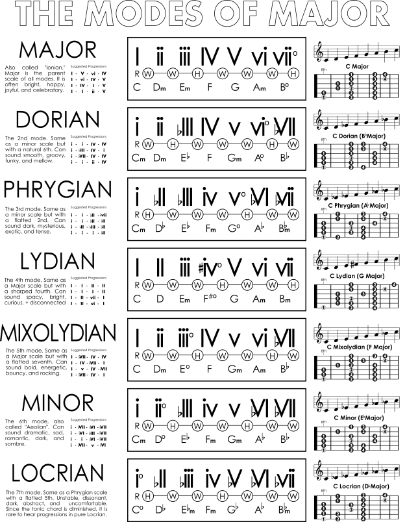
If you've been following along, you now know that each mode has its own tonic chord, built from the scale's 1st, 3rd, and 5th notes. The quality of that tonic chord has a lot of influence on the feeling of each mode.
Looking at our modal chart, we can see that Ionian, Mixolydian, and Lydian all have major tonic chords. Unsurprisingly, all three of these tonalities have a "bright" sound. If you're writing or soloing over a major chord, your three modal options for color are Ionian (the standard), Lydian (dreamier), or Mixolydian (more rocking, in my opinion).
Aeolian, Phrygian, and Dorian all have a minor tonic chord, and all three of those modes feel more subdued. Over a minor chord, we can play any of these three scales to develop a different feeling.
Locrian is its own conversation. We'll get to it.
This all matters because it can give you options. If your band starts jamming on a G chord, and the only scale you know is G major, then your solos will always sound bright and happy. But knowing that G Mixolydian also has a G major tonic chord means you could instead choose that scale for your solo, creating a rougher and bolder sound.
Exploring Each Mode Individually
We have a broad overview of the landscape now, and with that, we can begin to drill down deeper into the individual flavors of each mode. Each one will prefer certain chords and movements to really help its unique flavor bloom.
1. Ionian (the major scale)
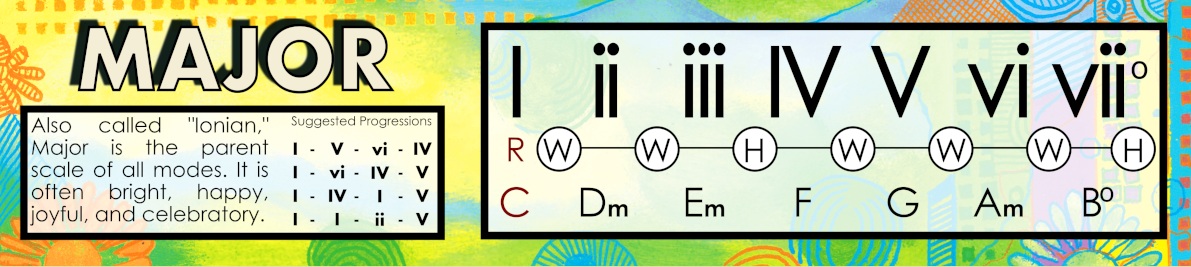
Although major might seem simple at this point, it's important that you understand the common tricks to writing in the major key. That way you can avoid them when trying to create a modal tonality.
And honestly, you shouldn't disregard it just because it's "simple." Some of our favorite music relies on only the major scale, and it's still the mode we hear every day on the radio. If you're looking for big catchy hooks, it's hard to go wrong with major.
So here's a lesson on writing chord progressions in major. It should be an easy lesson to digest after the heavy lifting we've already done.
Lesson: Writing Chord Progressions In Major
If that's too tame for you, check out how I write prog rock riffs in major in my Riffing With Modes series. The Ionian entry is in F major, but features a "relative modulation" to D minor. Basically, the tonal center just flips for a bit, but the same notes are in play start to finish.
Demonstration: Riffing With Modes - Ionian
2. Dorian (the 2nd mode)
Take a regular minor scale like A minor (A B C D E F G), raise the 6th note from F to F♯, and you've got A Dorian. That single note makes the whole scale feel different.
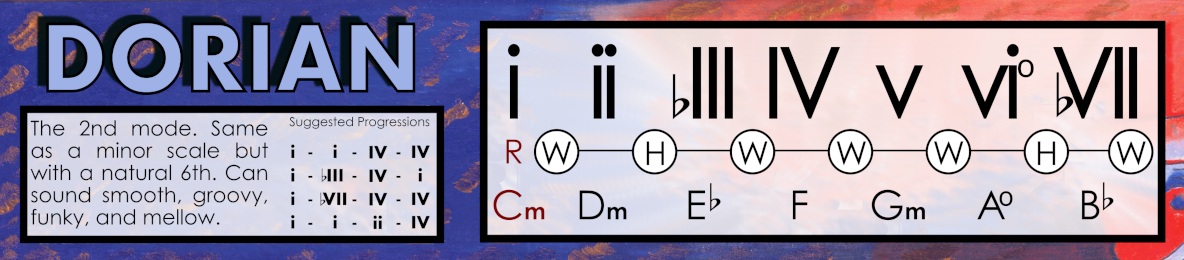
Dorian is the smoky, smooth, slightly optimistic alternative to minor. It's not really evil, and not really depressing, but it can have a sense of "wistfulness" to it. I think of the sound of Carlos Santana on a slow jam, or "Any Colour You Like" by Pink Floyd. It's also the foundation of a huge swath of jazz, which is why some players think of it as the "jazzy minor."
The simplest way to write something convincingly Dorian is the i-to-IV move. In A Dorian, that's A minor to D major. The reason this sounds like Dorian and not regular minor is that D major contains an F♯, that characteristic Dorian note. The moment you hear that major IV chord land, your ear knows it's not in plain old minor anymore.
When you're soloing over a Dorian progression, promote that natural 6th. Bend up to it, hold it, end phrases on it. That's the note that tells your audience which mode you're in and creates the signature Dorian sound.
Once you've got the basics of Dorian down, you should not hesitate to start jamming with it. It's super fun, trust me. Here's a track you can practice over:
If you want to see how Dorian can be used to write a full song with lyrics, drums, bass, and solos, you should check out my demonstration here:
Demonstration: Riffing With Modes - Dorian
3. Phrygian (the 3rd mode)
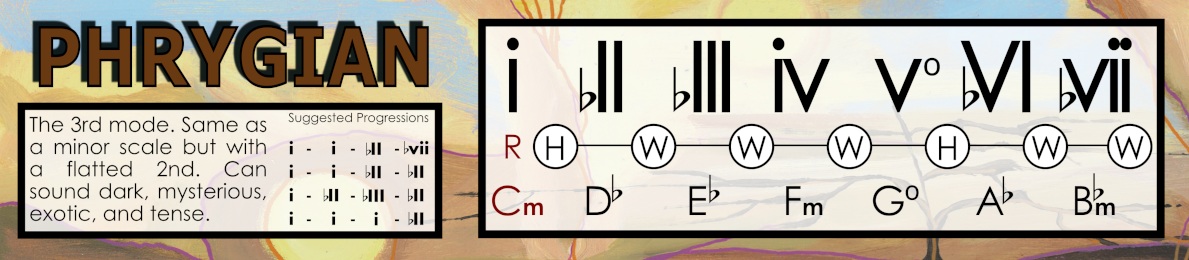
Phrygian is super dark. Not the sad kind, but more of the evil kind. The flat 2 sitting right next to the root creates a half-step tension that's basically the Jaws theme: you only need those two notes to make people uneasy.
You'll hear that tension in genres like flamenco, Middle Eastern music, and lots of metal. Metallica's "Harvester of Sorrow" and Megadeth's "Symphony of Destruction" both rely on this combination of notes. It's popular in rap and hip-hop genres for that creepy haunted-house vibe, as heard in Missy Elliott's "Get Ur Freak On". EDM, techno, and psytrance producers rely on this scale too, to create deep hypnotic dance grooves.
But truthfully, very little music is written entirely in Phrygian. What's much more common is for a riff or a section to dip into Phrygian for a few bars to create intrigue, then things go back to normal. If you want to write something that genuinely lives in Phrygian, the move I recommend is to pedal hard on your tonic note and let the melody snake around it, hitting the ♭2 and ♭7 to build tension before returning to the root. If you want to bring in another chord, consider ♭II or ♭vii, since both contain that signature ♭2 note, and both resolve well back to the minor i chord.
Here's a lesson on how that all looks and sounds in practice. By the end, you'll be able to actually compose music in Phrygian and write Phrygian chord progressions.
If you're into heavier styles of music, then you should definitely follow up that lesson with my demonstration of how I encoded secret messages using morse code into a metal song using the Phrygian mode.
Demonstration: Riffing With Modes - Phrygian
Note: there's also a popular variant of this scale called Phrygian Dominant which contains a major third, not a minor third. It's a mode of harmonic minor, which is outside the scope of this guide, but I still want to flag it here.
4. Lydian (the 4th mode)
Raise the 4th note of a major scale, and you transform it into a Lydian scale.
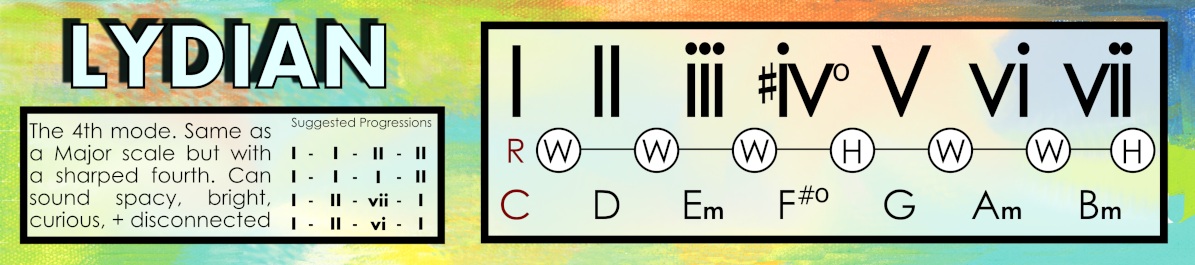
This one is my favorite. Composing in Lydian means we get to hear a major chord with a tritone over it, which turns out to be an awesome and desirable type of dissonance when used properly. The Lydian sound is usually dreamy, disconnected, and floaty, making it popular during the "wonder" cues in film scores, or prog-rock solos.
Practically, the four notes that carry most of Lydian's identity are the root, the major 3, the ♯4, and the 5. If you want to sound Lydian fast, just jam on those four notes and surround them with the rest of the scale only when you need motion. The trap to avoid is the V chord. In G Lydian, the V is D major, and if you play a D major chord for any length of time, your ear will probably "reset" to D major and you'll lose Lydian entirely.
Lydian tonalities are delicate and frail. It's inherently unstable, so you're best to stay on the I chord for as long as possible. Then dip into the II or vii sparingly.
In this lesson I explain all that while focusing on "riff writing" in Lydian. Not only will you learn how to write progressions in Lydian, you'll also learn a bit more about how to write guitar riffs.
Once again, if you want to see what this scale looks like "in the real world" as we compose with it, watch this lesson as I compose an instrumental prog rock piece in the style of Steve Vai. At least, that's what I hope it sounds like!
Demonstration: Riffing With Modes - Lydian
5. Mixolydian (the 5th mode)
Mixolydian is what you get when you take a major scale and lower the 7th note by a half step.
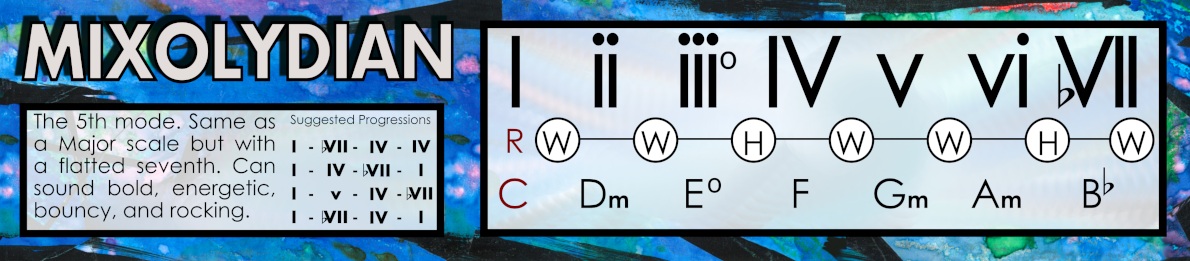
To my ear, Mixolydian sounds like major's slightly rougher, slightly cooler younger brother. It still has that bright energy, but the saccharine sweetness is scraped off. It's bouncy, bold, and generally speaking, awesome.
You've heard it in AC/DC songs, the verses of "Norwegian Wood," and "Sweet Child O' Mine," to name a few. It keeps showing up in rock songs because it's less "beautiful" than major but still catchy and optimistic. Mixolydian also turns out to be the natural tuning of the Highland bagpipes, which is why traditional Scottish music sounds the way it does. Once you start hearing the ♭7, you'll catch it everywhere.
The way I write in Mixolydian is to lean on the I-♭VII-IV move. In G Mixolydian, that's G to F to C. That's the kind of progression you hear AC/DC use in basically every song they've ever written. If it was good enough for them, it's good enough for me.
I also really do love the sound of the minor v chord that this scale contains. Moving from I to v and surrounding that movement with the Mixolydian scale is a wonderful sound that hovers between morose and excited.
To get a taste of how to write Mixolydian progressions, and how to solo using the Mixolydian scale, I made this lesson:
I take this concept to extremes in another lesson where I write an entire rock song in Mixolydian. I personally think if this song was released in 1986 it would be a hit, but I'm a bit biased.
Demonstration: Riffing With Modes - Mixolydian
6. Aeolian (the natural minor scale)
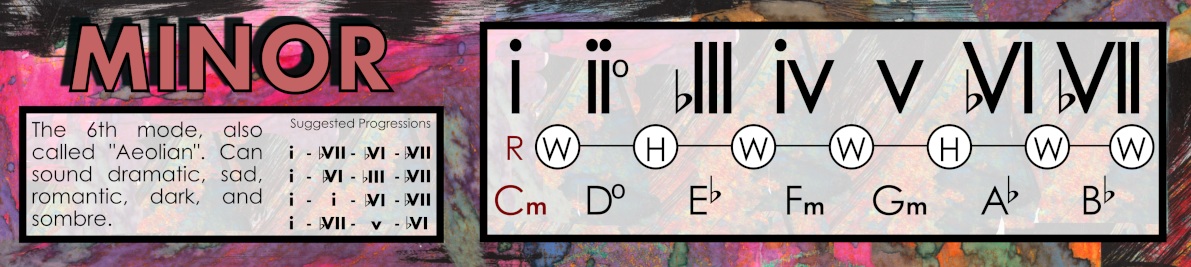
You already know this mode. But there is much more to composing in minor than we'll be discussing here, because the minor key opens up the doors to scales that aren't modes of major.
Specifically, writing "in minor" means introducing a scale called harmonic minor. That isn't a mode of major: it's an independent and sovereign scale with its own properties to consider. It helps create a V chord in minor keys, which is one of our favorite musical movements (V to i).
To get an idea of what the minor key really means, here's a lesson I taught on writing chord progressions in minor keys. You'll get the basics quickly, and then learn about how harmonic minor and the leading tone appear in minor keys.
Lesson: Writing Chord Progressions In Minor
That lesson will open up the door to exploring harmonic minor, which you'll find in this series:
Series: Exploring Harmonic Minor
Lastly, here's an outrageously fun demonstration of what it means to write in Aeolian across three different genres:
Demonstration: Riffing With Modes - Aeolian
7. Locrian (the 7th mode)
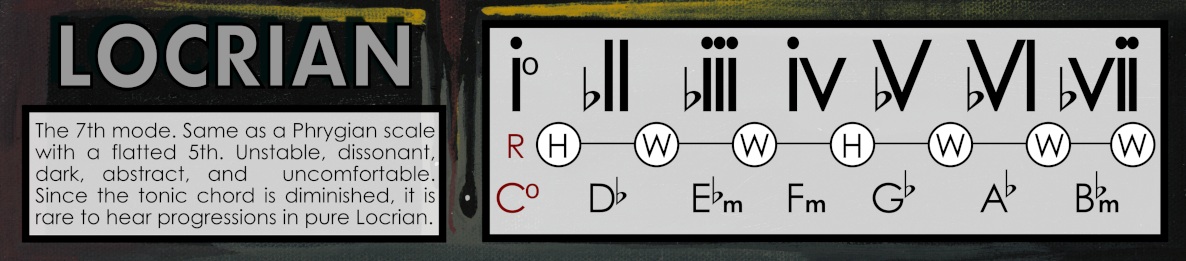
I'm going to be harsh here. I consider Locrian the leftover mode. Music doesn't get written in Locrian by accident because it sounds clumsy and awkward. It's a scale you really have to go out of your way to try to use.
The main reason is that it doesn't have a stable tonic chord. Every other mode was centered around either a major or minor triad: those chords can easily stand alone for long periods of time and feel at rest. You can build a home on them. Locrian's tonic chord is diminished, which isn't the kind of chord you can just sustain forever. Your listeners will revolt, since diminished is a chord that wants to move somewhere, not stagnate.
You can technically write in Locrian. I've done it before in my Riffing With Modes series. But for the purpose of this page, I'd rather be honest with you: if you want a weird, atonal, unstable sound, you don't need to "stick to a scale" or abide by any rules.
It's worth knowing it exists and worth understanding why it doesn't work. That's most of the value here. But if you're a jazz player, and are frequently confronted with various types of diminished chords, you will find more use for this scale as a soloing device.
However, it's a rite of passage for every music nerd to try to compose in Locrian. I did just that, and made the process even weirder by using a random algorithm derived from Pascal's triangle. The result is unsettling and certainly interesting - whether or not you "enjoy" it will be a totally different story.
Demonstration: Riffing With Modes - Locrian
How To Actually Use Modes
Putting all of these concepts together will help us understand how modes actually get used in the real world. The seven approaches I lay out in the video below come straight from chapter 21 of The Chord Progression Codex: stay within one mode, break the structure on purpose, modulate between relative modes, and four more.
If you want a fuller written breakdown of the first three techniques, I wrote one out on the companion lesson page.
Going Deeper
This is a good start, but there's plenty more to discuss. Most importantly - chord theory. The better you understand chords and how they form sequences, the better your modal music will sound. The best way to learn that stuff is with my book, the Chord Progression Codex. It's over 400 pages of songwriting gold, at least according to the reviews.
Book: The Chord Progression Codex
Another topic we've ignored is modal mixture, which is a way of combining these many flavors into a single dish. I have a few lessons on the topic and more to come, but here's a few to try out:
And lastly, we didn't discuss anything in this guide outside of harmony - that's only one element of music. What about bass, rhythm, structure, melody, groove, lyrics, and the rest? Those are the things we usually need to write a song that people want to hear, and they're exactly the topics I teach in my Theory and Songwriting course. It covers all the elements that really matter for a modern songwriter. Check the reviews to see if it's right for you.
Course: Theory and Songwriting
The Full Series
Here's the entire playlist: 8 video lessons that cover all the important aspects of modal harmony, from parallel and relative modes to fretboard shapes and real-world songwriting applications.



Frequently Asked Questions
Is a mode a scale?
Yes - all modes are scales, but not all scales are modes of the major scale. Once you have any scale, you can just reorder it or rotate it and create one of its modes.
Are modes keys?
Technically, there are only two types of keys: major and minor. I certainly like to think of the modes as being their own independent keys because it helps really promote their unique sound. But many musicians will just see these as major keys with modifications.
The major key sometimes sees its seventh note get flattened, which creates Mixolydian. Or it may see its fourth get raised to create Lydian. These are all just variations of the major key, and not necessarily keys themselves.
But obviously, each mode itself does derive from a major scale, and can be associated with a key. That may not be helpful though.
Can other scales have modes?
Yes - scales like melodic minor and harmonic minor are frequently reordered into modes. These scales provide even more choices for us as composers, and unique flavors and moods that don't appear in the regular modes of major.
What is the most popular mode?
That depends on the genre of music. For rock and pop, I'd say Mixolydian and Dorian are the most popular (outside of major and minor). Jazz and funk will certainly see more Dorian, and Lydian is often heard in progressive or orchestral styles.
Can you write in a mode?
Absolutely. It's the best way to really hear and feel the flavors of that mode. You compose only with the notes of a mode, and really stress a strong tonic chord. That will do the trick!
What is the difference between relative modes and parallel modes?
When you take the notes of a major scale and reorder them, you discover relative modes. For example, C major (CDEFGAB) can be reordered into D Dorian (DEFGABC), which makes them relative.
Parallel modes begin on the same exact note. C major and C Dorian are parallel, they do not contain the same notes!