


Creating The Impossible Rhythm Illusion From "The Odyssey"
"Troy," from The Odyssey soundtrack, sounds like it speeds up forever. This auditory illusion is generated by the clever use of several composing tricks.
By Jake Lizzio · Signals Music Studio · 700,000+ subscribers on YouTube
When I left the theater after seeing the Odyssey, all I could think about was the song that played during the fall of Troy. It sounded like it was constantly speeding up, but the instruments themselves never surpassed a certain tempo.
Even after several listens, I wasn't quite sure exactly how the composer (Ludwig Göransson) pulled it off. But after recreating the track in Ableton, I believe it boils down to four main tricks.
To understand how they all work together, it's best to examine the Shepard tone, and how it led to the creation of the Risset Rhythm.
The Shepard Tone is an Infinitely Rising Pitch
This audio sample here gives us the illusion of an infinitely rising pitch.
What you're hearing is not one pitch, but several, spaced out across octaves. As the highest voice climbs, it slowly fades out and your ear loses track of it. When this happens, your ear tends to "reset" by finding the same pitch but in a lower octave.
While that's happening, a low frequency is slowly getting faded in, allowing the infinite cycle to continue where it started.
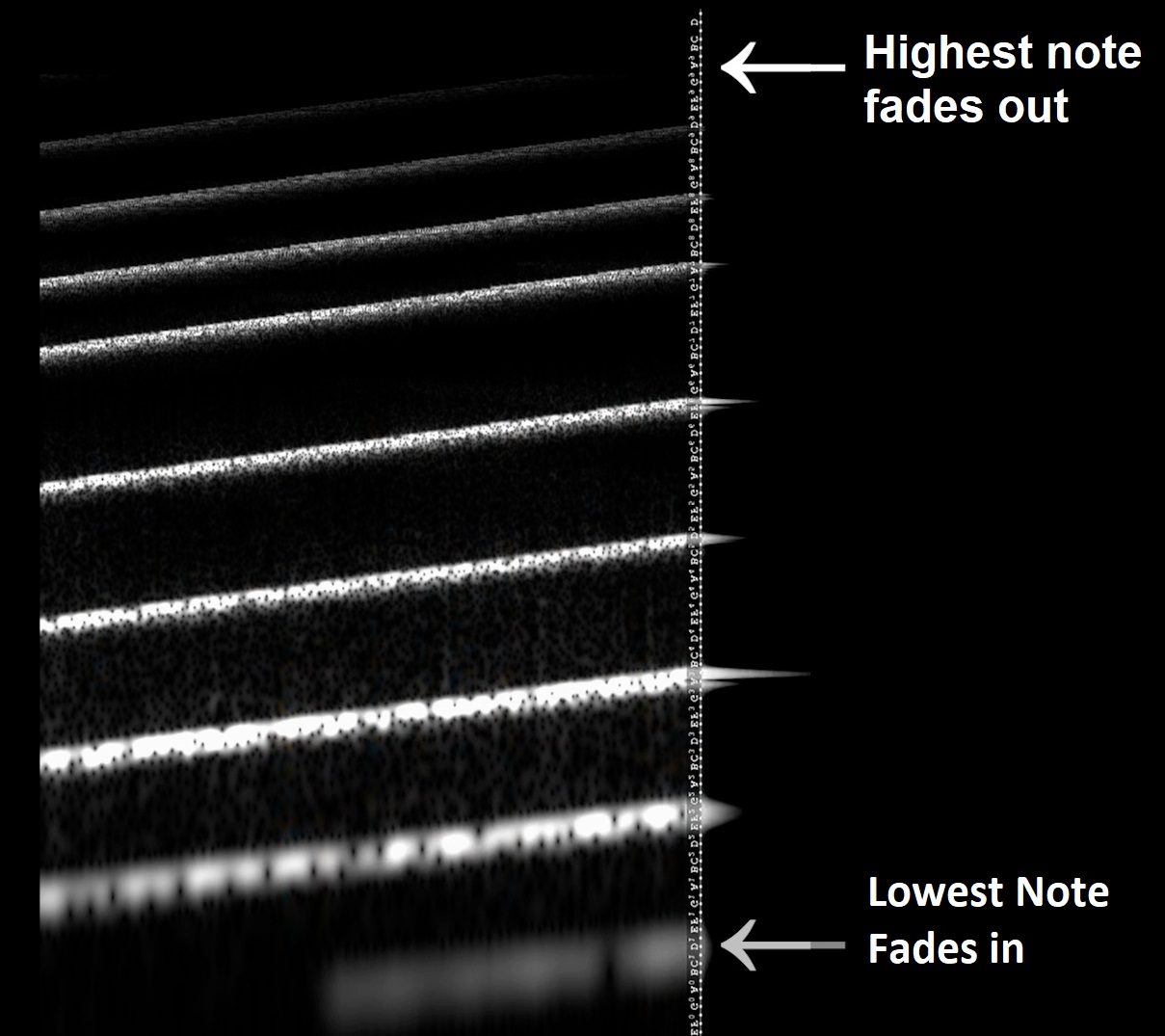
This phenomenon, developed by Roger Shepard, led to the creation of the "Risset Rhythm."
The Risset Rhythm
The Risset rhythm is named after French composer Jean-Claude Risset, who transformed Shepard's illusion from a melodic one into a rhythmic one using the same fade-out trick.
To create a Risset Rhythm, take a simple pattern, and overlay it with copies of itself at half speed and double speed. Fade these in and out, respectively, and let the pattern loop.
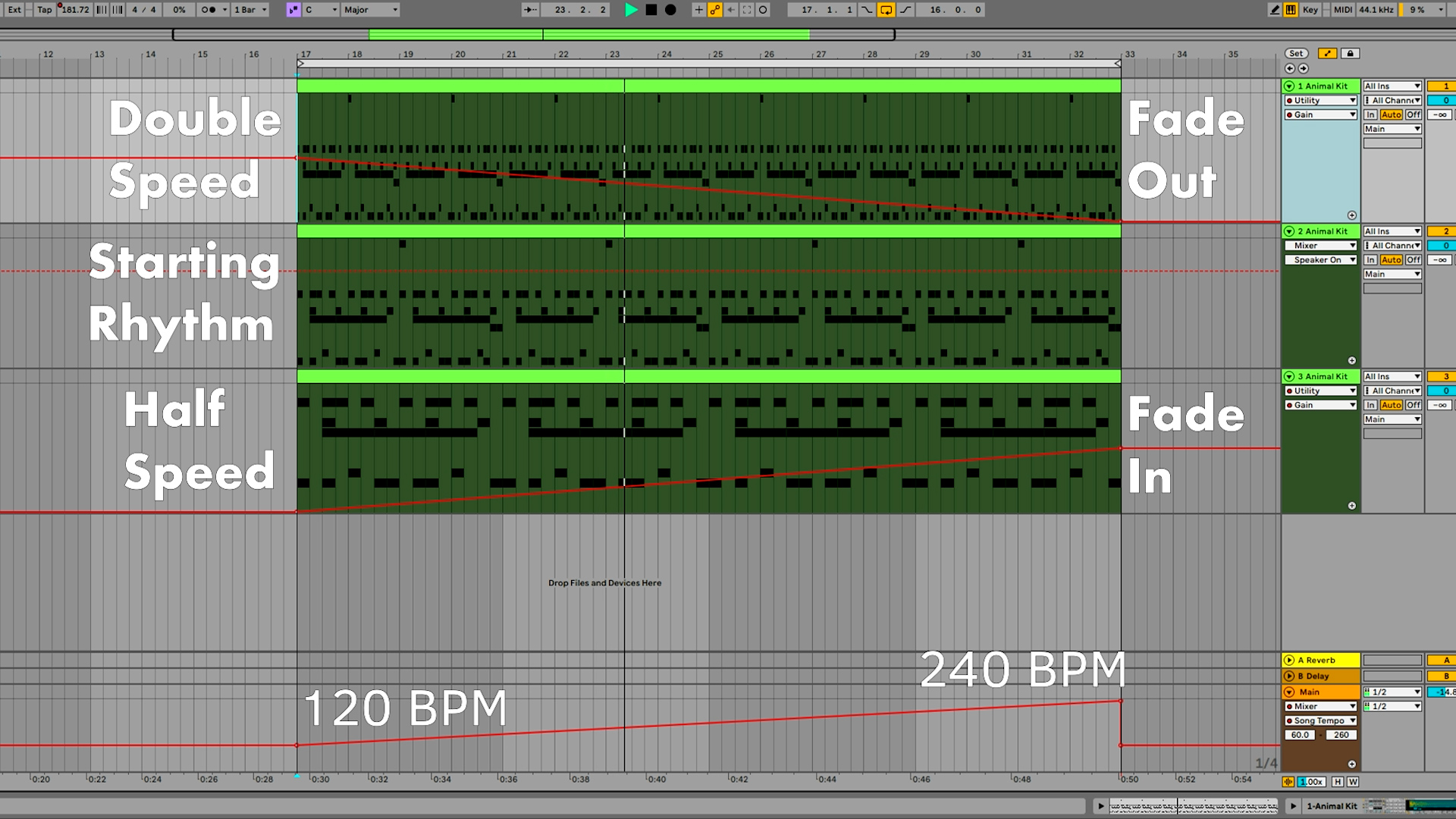
These two phenomena both employ the same technique to create their illusion - fading something out so your ear loses track of it. This is the first trick that you'll hear all across "Troy," especially in the second half. Layers that get introduced become hard to follow, since they're gradually faded out and overpowered by new layers.
But Göransson does much more than just that - the way the tracks dovetail into one another is more of a composing technique than it is a mixing task.
Dropping Subdivisions
The second trick you'll hear in "Troy" is quite simple, and is easy to experience with a group of just two pulses.
We can take a grouping of two, and speed it up. As the tempo increases, we can gradually fade out every 2nd note until it vanishes completely. Once the tempo has doubled from its initial state, we'll be right back to the same rhythm and speed we started at, and can repeat the trick.
This technique is used across every layer in the track. However, the rhythmic cycles used are far more complex than a simple grouping of 2.
Hemiola
Let's begin with 6 steady pulses. As they speed up, we'll again gradually fade out every other note to leave us with a copy of the original pattern at half speed.
Now let's layer in the identical pattern on a different instrument, like a kick drum, but played at half the speed. This divides the original pattern into three steady beats, which we would call a 3/4 feel.
Lastly, we'll copy the first layer again, but slow it down to 1/3 speed. This divides the original pattern into two steady beats, which we'd call a 6/8 feel.
And now notice - we have a steady pulse of three happening on top of a steady pulse of two. That's a 3:2 polyrhythm, or "hemiola."
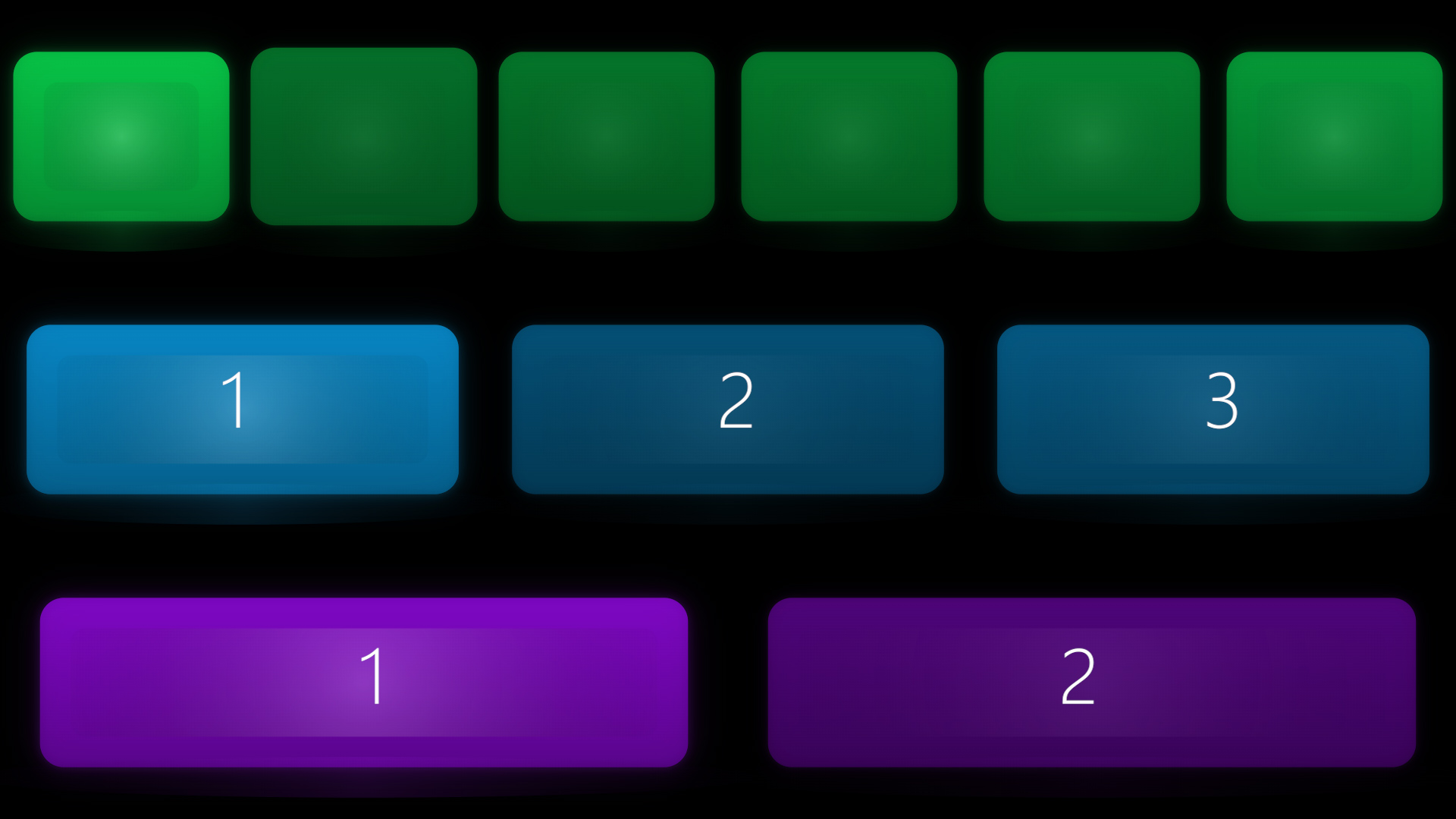
At every point of this track (the second half), you can pick up on either pulse. And when introducing new layers, Göransson can work off of either, allowing infinite possibilities. Additionally, layers that might be playing 3/4 in one section may start playing 6/8 in the next, or vice versa.
Ultimately, this creates an intricate and complex tapestry of rhythms that become very difficult to track. But the final trick in the song is quite simple.
Rising Pitch Against A Drone
The easiest way to create tension or suspense is to start with two voices playing the same note. One will sustain, while the other slowly rises. This is a classic composing cliche that is not beneath the great Göransson.
This element only adds to the eternally rising anxiety that the original track induces.
Trying It For Myself
To create my own track with an infinitely rising tempo in Ableton Live, I started with three tracks at 150bpm, and worked with groupings of 6 quick pulses.
Layer 1 (the woodblock, and later, the flute) plays all 6 pulses, but gradually fades out every 2nd note as the tempo slowly doubles.
Layer 2 (the kick drum) plays in 3/4 by playing every other pulse. Again, the subdivisions are faded out as the tempo increases.
Layer 3 (cinematic drums) plays in 6/8 by playing every third pulse, and like before, it transforms through dropped subdivisions.
I automated the tempo to double to 300, and then copy-pasted the same tracks but at half-speed. This was repeated to 600 BPM, but I was unable to double again because of Ableton's limitations, so I reset the tempo back to 150 and returned to the original note lengths.
Then I added in a single bongo part that fades in and shifts through different rhythm patterns, but still employs the "fade-out-subdivisions" trick.
Lastly, I created some creepy ambience using the two-voice-pitch-bend-against-a-drone technique I mentioned earlier. That wasn't enough for my liking though, so I recorded some distressed moans and processed them through Valhalla Supermassive.
Metric Modulation and Fractal Polyrhythms
What's occurring throughout this example is a bizarre type of metric modulation, which I teach in Real Rhythm Guitar: Level 2. If you're a guitarist that's confused about rhythm and struggling to keep time with a band, the Real Rhythm Guitar series is literally guaranteed to fix that (it comes with a money-back guarantee).
But these specific examples can also be thought of as exhibiting fractal, self-similar behavior. All we're doing is "zooming in" on a rhythm, which turns out to be an identical copy of the initial rhythm, just at a different speed.
More Rhythm Lessons
If you enjoyed this lesson, I have a feeling you'll enjoy these as well:
Understanding Hemiola (The 3:2 Polyrhythm)