

Why is the 9/8 Time Signature So Confusing?
Music teachers are still teaching 9/8 in a way that doesn't always make sense to modern musicians. We'll explore the conflict and explain both perspectives.
By Jake Lizzio · Signals Music Studio · 700,000+ subscribers on YouTube
Understanding the 9/8 Time Signature
There's a lot of confusion surrounding this time signature because music teachers tend to teach it one way, while music players and learners tend to encounter it another way. This is because the music theory you learn at college doesn't always reflect the theory behind modern trends and teaching concepts. To master the topic I've made the video above which I highly recommend watching all the way through.
To summarize the issue, the following blog will hopefully explain the difference between simple meter, compound meter, and how they affect our choice of time signature. By the end you should understand why 9/8 and 6/8 are more flexible than you might have thought.
If you're struggling with understanding rhythm on guitar, I have an entire course that teaches rhythm guitar skills along with rhythm theory.
The Classical Perspective
Most music students are taught a very rigid definition of the 6/8 time signature. Let's explore that first to better understand 9/8.
To begin, let's look at a measure of double meter. That means a measure with two even pulses in it. We would count it "one - two."
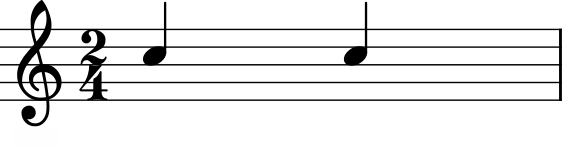
We might choose to take each of those pulses and subdivide them into two, creating eighth notes. That would be called simple double meter. "Simple meter" just means that every pulse is divided into two.
Notice how this measure contains four eighth notes. We would count this measure as "one - and - two - and."
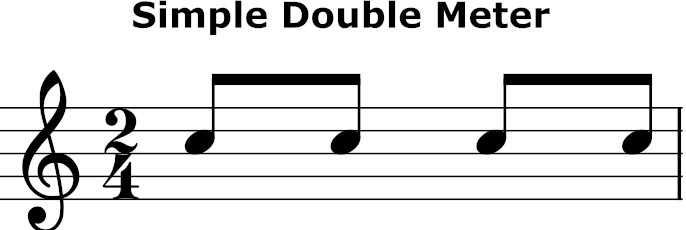
We might also choose to take those two pulses and subdivide each one into three, creating the following structure known as compound double meter. Compound meter means every pulse is divided into three.

Notice how this measure contains six eighth notes. In simple meter we normally count eighth notes as "one-and-two-and." In compound meter, music teachers usually tell their students to count the eighth notes differently, "one - and - ah - two - and - ah," as shown above. This verbally creates the compound double meter feel. We have two pulses, (one two), and each one is felt as a grouping of three.
In the classical world, the 6/8 time signature is "reserved" for this exact feel. If you have a piece that has a strong two-pulse drive, and each pulse is neatly divided into threes, then this time signature will look neat on the page and easily convey the rhythmic information.
Why 6/8 = 2/4
Be aware: the above time signature of 6/8 will sound identical to a measure of 2/4 filled with 8th note triplets. In 2/4 we have two steady beats, and if each of those beats is divided into three, then the overall rhythm will be the same.
Triplet signs are cumbersome and unsightly to write across a whole page. If an entire piece is two pulses + three-per-pulse, than the 6/8 time signature is just cleaner and usually preferred.
The 9/8 Time Signature
Let's apply those same thoughts to triple meter, which means a measure containing three steady pulses. Here's a standard measure of triple meter:
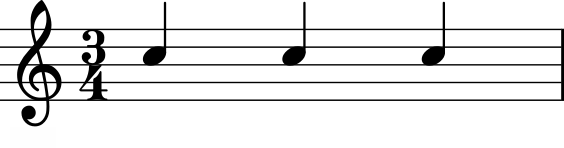
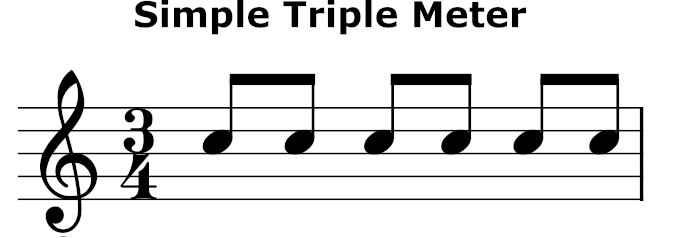
We can take each of those pulses and divide them into two, creating simple triple meter. Notice how this also contains six eighth notes, like a measure of 6/8, but they're grouped together in twos. This is why we'd write this measure as 3/4 and not 6/8.
If we choose to take each of those pulses and divide them into three, we'd end up with 9 counts in total. This is compound triple meter.

In the classical world, this is what the 9/8 time signature is used for. Three steady pulses, with each pulse being divided into three.
This exact same sound can be recreated in the 3/4 time signature with steady 8th note triplets. That means that 9/8 and 3/4 can be heard and felt as the same depending on the groupings and accents in the measure.
The Jazz/Rock Perspective
When you leave classical studies behind, these definitions quickly lose their stability. In the real world of modern music, songs rarely adhere to just one rhythmic pattern like the ones we've described.
For example - a measure of 9/8 to a classical music student will probably inspire the feeling of three steady pulses, each divided into three ("one and ah two and ah three and ah"). But to a rock, jazz, or metal player, the idea of a 9/8 measure might mean "four and a half pulses."
Listen to the beginning of Voices by Dream Theater. You should be able to feel four long pulses, then one quick one. That's a measure of 9 eighth notes, but clearly, there is no three-per-pulse feel occurring. Rock students may count this rhythm using regular eighth note patterns ("one and two and three and four and five")
The 6/8 time signature is also one that does not need to occur in a strict 3-per-beat time signature, and does not necessarily need to be counted "classically." For a fun demonstration of how 6/8 and 3/4 can intermingle with one another, watch this lesson and demonstration on hemiola.
The Bottom Line
The way we phrase and group our notes will influence the time signature we use in our notation. Don't let classical traditions define your modern songwriting, and try your best to understand why different musicians might notate the same rhythm in different ways. A measure of 9/8 doesn't need to feel like 3 steady pulses, and only thinking of it through that lens will limit your rhythmic choices.