


Master of Puppets Interlude Explained: Music Theory Breakdown
Breaking down the iconic interlude from Master of Puppets, then using those strategies to write original music.
By Jake Lizzio · Signals Music Studio · 700,000+ subscribers on YouTube
Right in the middle of Metallica's "Master Of Puppets" exists a peaceful and serene interlude - an clean break featuring harmonized guitars and a repeating loop of sustained arpeggios. It's a beautiful section of music that I was totally obsessed with when I first started learning guitar, and at that time I had no idea how anyone could write such a piece. Many years later I sat down to study that section, and was delighted by what I found - a perfect demonstration of simple compositon techniques used wisely.
We'll go through those techniques, and then at the end, use them to make our own original music that retains all the qualities of this interlude but still sounds unique.
Making 4/4 Sound Weird
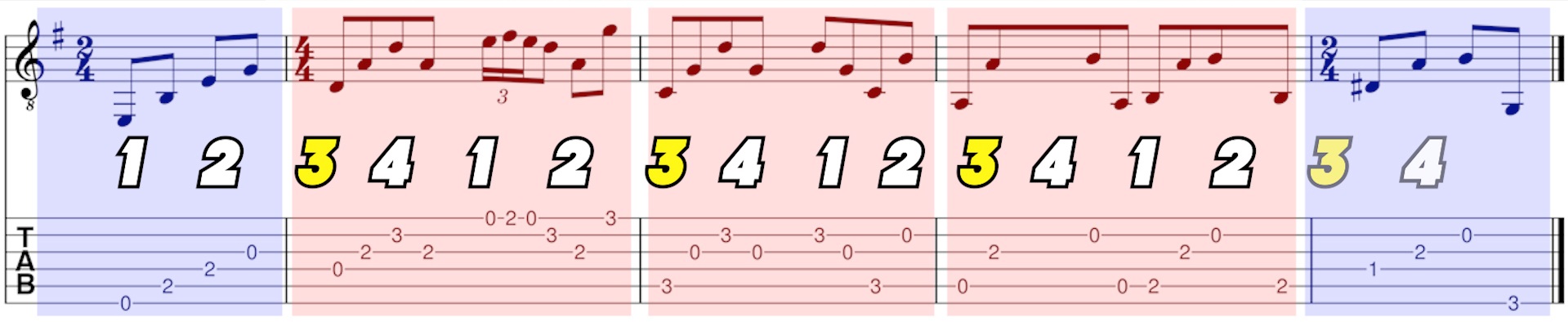
The entire section consists of 16 beats, but they're not evenly grouped into four groupings of 4. Instead, the structure is more like 2 + 4 + 4 + 4 + 2. That all adds up to 16, which makes it easy for Lars Ulrich to play a slow half-time drum groove over the entire section. That choice places the snare drum in an interesting location, and in typical Lars fashion he accents some of those hits with crash cymbals too, creating a surprising and off-kilter groove.
Diatonic Chords from the Minor Scales
Most Metallica songs are written in the key of E minor, which means they revolve around an Em chord (or tonal center) and heavily feature the notes and triads of the E minor scale. (You can play with these chords on my diatonic calculator, found here)
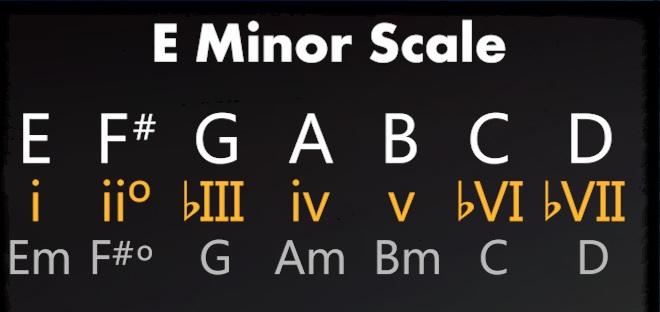
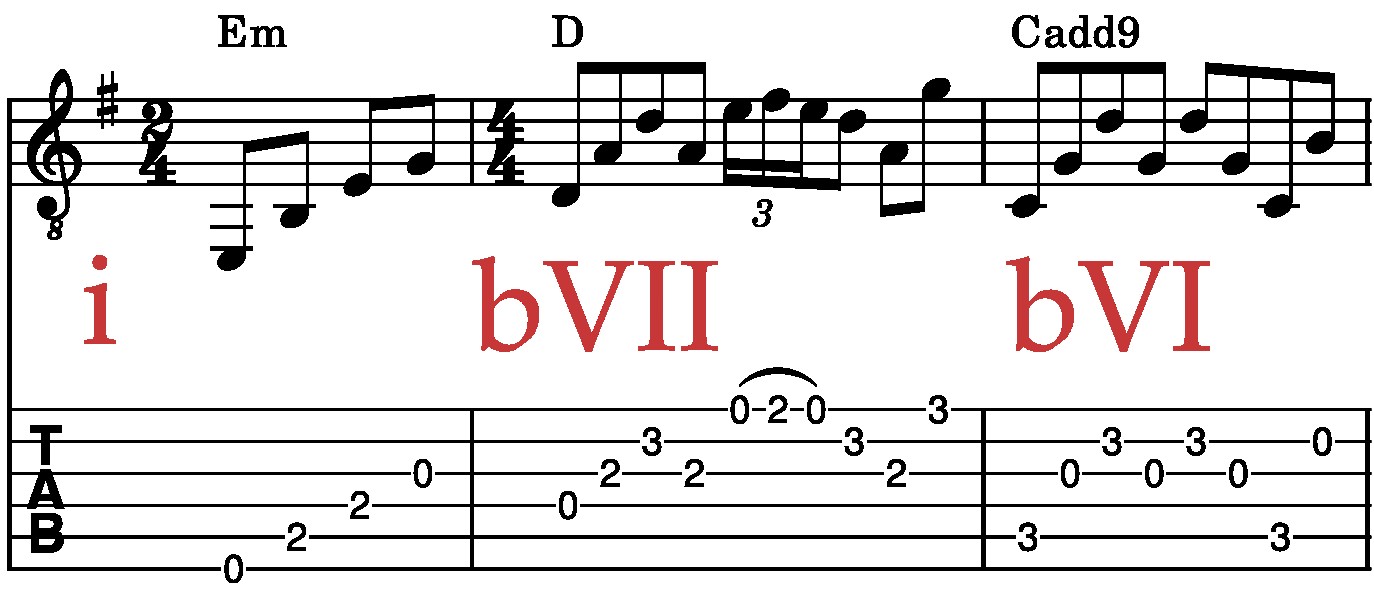
The first three chords in this section are just simple variations of Em, D and C, which are the diatonic i, bVII and bVI chords in this key. The D is embellished with suspensions (Dsus2 and Dsus4), while the C is swapped out for a Cadd9. All of these enhancements stay true to the Em scale.
Introducing Harmonic Minor
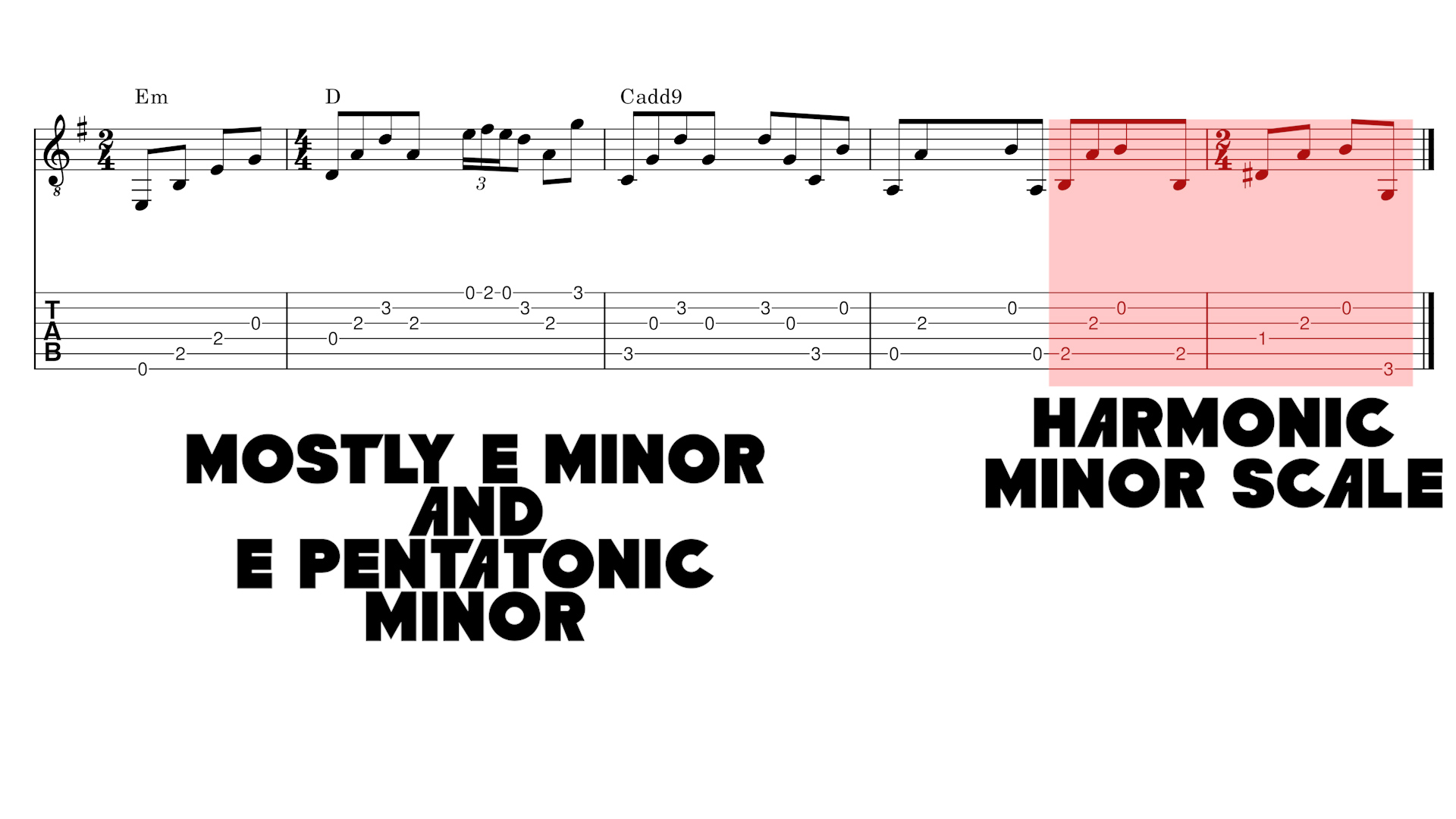
The last 6 beats shouldn't be thought of as purely chords though. Instead, it's easier to separate what's going on here into two halves - the low stuff and the high stuff.
Observing just the low notes, we see they play the following scale degrees: 4 -> 5 -> 7. That natural 7th, D#, is not in the minor scale. But we shouldn't be surprised to see it appear here; writing in minor keys means we're likely to see the key's 7th note get raised, which creates the harmonic minor scale.
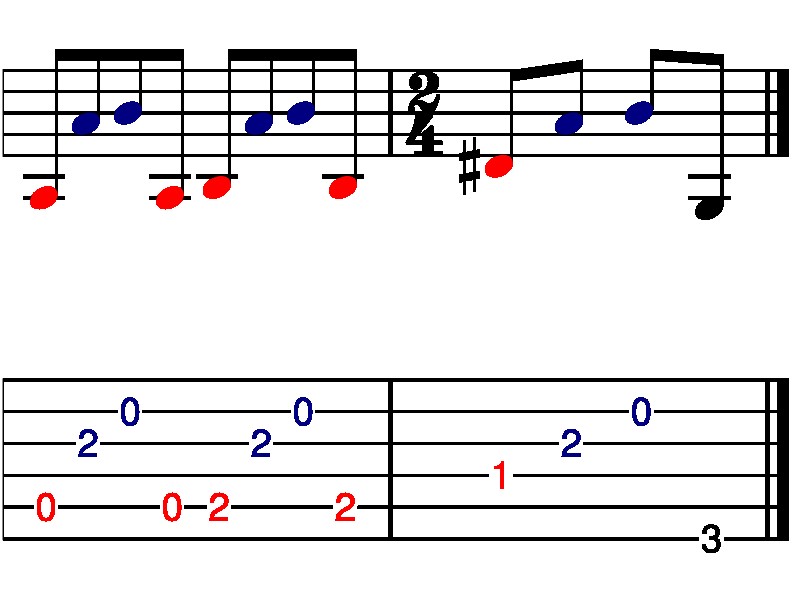
After each of those low notes, the higher notes simply repeat scale degrees 4 & 5 (A and B). This creates a type of pedal-point, where we have something steady on top but something changing underneath. This motion naturally creates most of a B7 chord at the end.
Lead Arpeggios
Kirk Hammet simplifies each chord and plays its arpeggio. Over the Em chord, he plays those notes, E - G - B. Instead of Dsus2 or Dsus4, Hammet simply plays the notes of a D major chord (D - F# - A), and over the Cadd9, just plays the notes of a C chord (C - E - G).
These last few beats have already been established as "not-quite-chords" though, which means we shouldn't be surprised to hear Hammet ditch this strategy of simply matching the underlying chord to an arpeggio. For this moment, he chooses to simply play through the harmonic minor scale with up+down motion, introducing classical "flare" and tension to the moment.
Imporantly, he begins playing the scale a bit before he's really being asked to (by that B7 chord, which clearly is crying out for D# and not D natural). That choice is wise, since it gives our ear a quick preview of what's about to come, and also doesn't interfere with anything the rhythm section is playing. Since these last 6 beats don't include any references to a D note (like other chords, Cadd9 and D do), he's free to play E harmonic minor instead over this entire section.
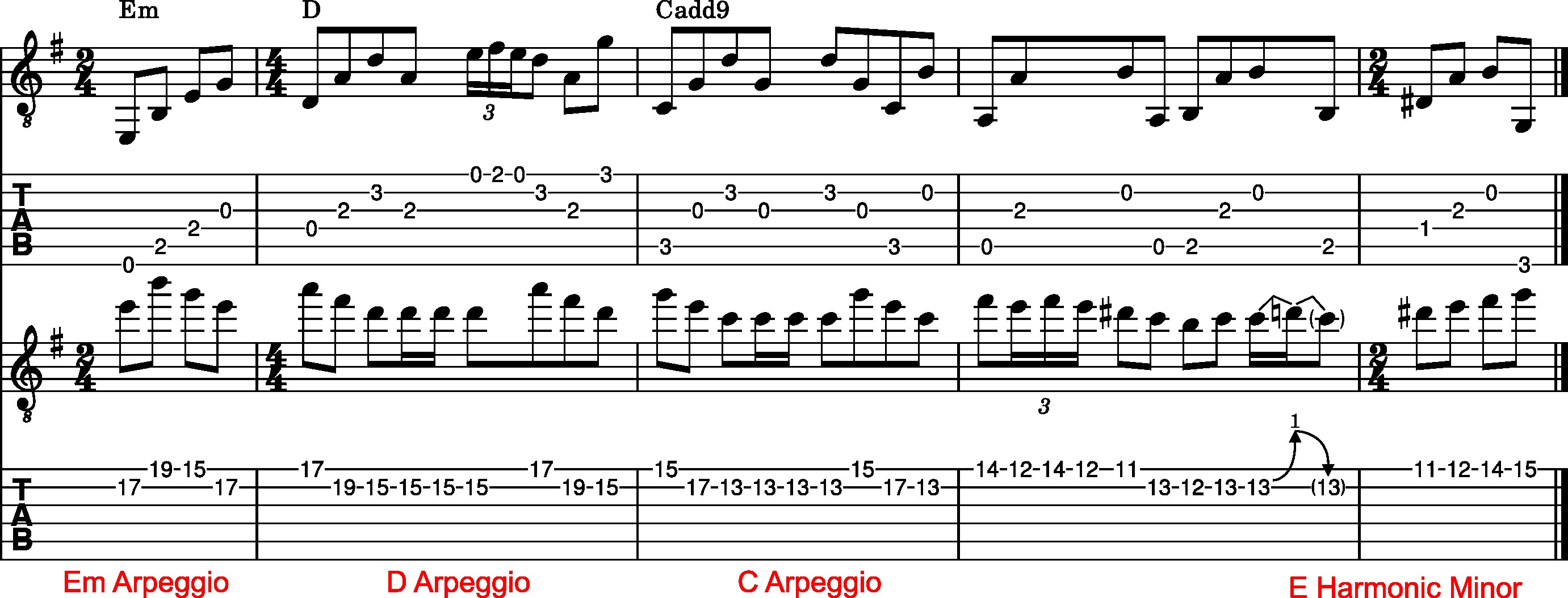
It’s worth noting that during that bend near the end, Kirk actually plays a natural D, meaning that he quickly switches between Harmonic, then Natural, then back to Harmonic minor in just the span of a few beats.
Harmonized Guitars
The wonderful harmony part for this lead is as simple as it gets. Go up a diatonic third- that's it! I explain diatonic harmony in this lesson here.
The Solo
After the harmonized arpeggios, Hammet plays a melodic solo that mostly sticks to the notes of the E minor scale. Over the first appearance of B7, he ignores the shift to harmonic minor that the harmony is pleading for, instead opting for the bluesy rocking soulfulness of E pentatonic minor. The second appearance of B7 is then treated with E harmonic minor, adding drama and tension before the arpeggios repeat.
Composing Your Own Version
Once you’ve broken a song down to its elements, like we’ve done here, it’s quite easy to rearrange those elements into a new piece of music. If you’re sly, you can avoid sounding like your reference track altogether, but today we’ll try our best to sound like Metallica without completely ripping them off.
First, I wrote a section that takes up 16 beats, but is split into groupings of 2 + 4 like we saw Metallica do. Then I assigned chords to those measures, all coming from the key of D minor. I chose to avoid E minor since nearly all Metallica songs are in that key, and picking a different key will help it sound a bit more original. The chord progression is essentially i - bVI - iv - V7, which is Dm - Bb - Gm - A7. However, I kept an E present in most of these chords, which creates the following chord labels:

Next, I copied Hammet’s strategy for a lead line by playing arpeggios over the first three chords and simply playing D harmonic minor over the last measure. And like Hammet, I harmonized this with diatonic thirds.
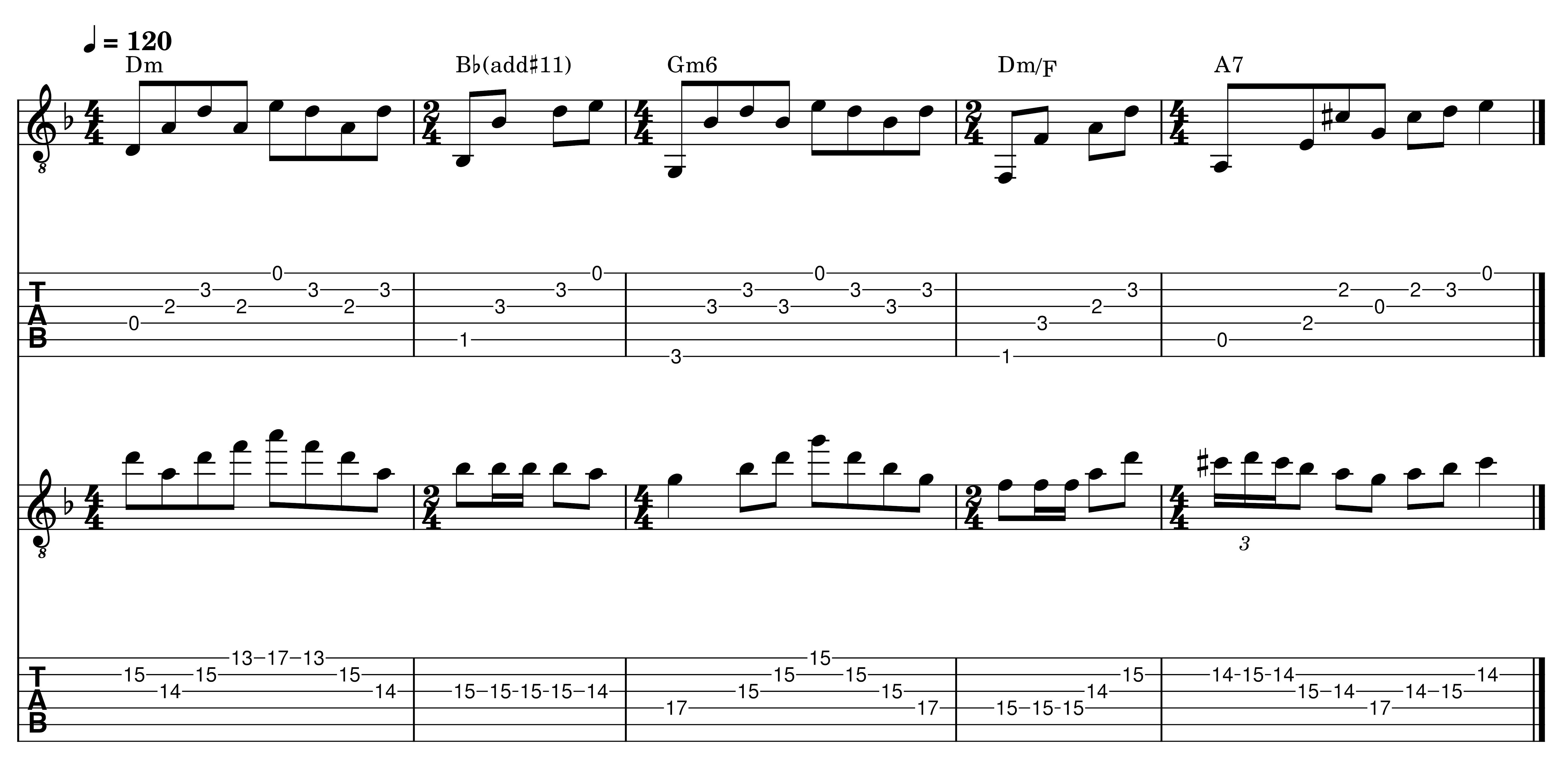
Lastly, I wrote a solo over this that departs from arpeggios and instead plays more scale runs. To again reference Hammet’s style, I opted for D pentatonic minor in lieu of harmonic minor over the first dominant chord to provide some bluesiness, and then featured harmonic minor at the end before things repeat.
Here’s what it sounds like when you put it all together:
The Best Composing Exercise
I think this kind of exercise is one of the best you can embark on as a composer. I’ve demonstrated this type of thing before in my videos on decoding Dream Theater, and again with Metallica’s song “Orion”.
If you’re looking to understand music theory better, and make songwriting easier, then you can learn even more from my Theory and Songwriting course. It will take you from the absolute basics, and get you comfortable writing all elements of a song - the chords, leads, lyrics, drums, and bass.
Or if you’re just interested in learning more about chords + progressions, check out my book the Chord Progression Codex. Metallica is specifically discussed in the section on dominant chords, along with many other artists and examples.